Working draft — to be validated with a food safety consultant before production.
1. Purpose
This procedure describes the production and bottling of the pineapple sauce without hot-filling the container. Microbiological safety does not rely on cold-sterilizing the product (unrealistic with manual equipment), but on stacking several complementary barriers.
2. Principle: the multiple-hurdle approach
No single barrier guarantees safety on its own; it is their combination that stabilizes the product and makes the file certifiable (UNBS / HACCP):
Controlled acidity (low pH) — blocks pathogens, including C. botulinum.
Food-grade preservatives — against yeasts and molds.
Flash pasteurization of the product — reduces microbial load; the product is cooled before filling, so the container never sees the heat.
Chemical sanitizing of containers — the “cold” equivalent of sterilizing bottles and caps.
Glass option — a post-sealing water-bath pasteurization brings the result close to true sterilization, with no deformation risk.
3. Process diagram
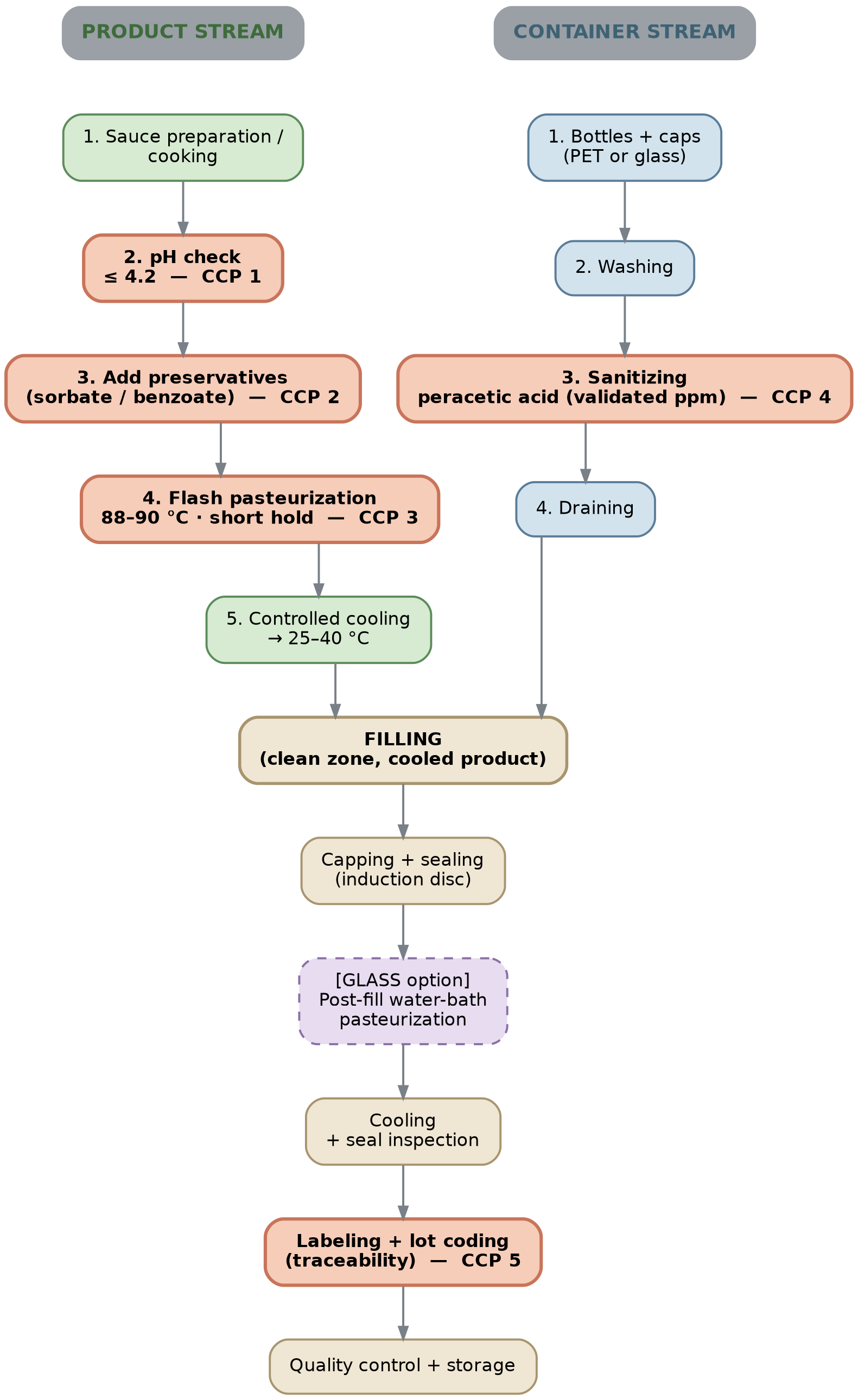
Orange blocks mark the critical control points (CCPs) to monitor and record for every lot.
4. Step detail and critical control points
Step | Target parameter (indicative — to validate) | CCP | Record |
Product stream | |||
1. Preparation / cooking | Standardized recipe, homogeneous mix | — | Recipe sheet + lot |
2. pH check | pH ≤ 4.2 (target ≤ 4.0). Barrier #1 against pathogens. | CCP 1 | pH-meter reading / lot |
3. Add preservatives | Potassium sorbate ± sodium benzoate, dose set by pH | CCP 2 | Weighing + dose / lot |
4. Flash pasteurization | 88–90 °C, short hold (schedule to validate). Treats the product, not the bottle. | CCP 3 | T° / time curve / lot |
5. Cooling | Down to 25–40 °C before filling (protects PET) | — | Fill T° reading |
Container stream | |||
1. Bottles + caps intake | PET or glass, 21-410 neck compatible with spout + induction disc | — | Delivery note |
2. Washing | Potable water, remove dust / residues | — | — |
3. Sanitizing | Food-grade peracetic acid, validated ppm + contact time (no-rinse) | CCP 4 | Concentration + lot |
4. Draining | Full draining, containers inverted | — | — |
Convergence | |||
Filling | Clean zone, cooled product, fill to target volume (250 ml / 100 ml) | — | Volume / lot |
Capping + sealing | Induction disc (works cold) + flip-top cap | — | Visual check |
Glass option: water bath | Sealed bottles immersed in hot water → post-fill pasteurization | — | Bath T° / time |
Cooling + seal inspection | Check induction seal integrity (vacuum effect) | — | Seal check / lot |
Labeling + lot coding | Lot number + best-before date; end-to-end traceability | CCP 5 | Lot register (ERP) |
Quality control + storage | Per-lot sample, storage, shelf-life monitoring | — | QC sheet / lot |
5. Minimum equipment (manual POC)
Pot / vat for cooking and flash pasteurization, with a reliable thermometer.
Calibrated pH-meter (systematic measurement per lot).
Manual piston filler.
Manual capper + portable induction sealer.
Sanitizing tubs (peracetic acid) + draining rack.
Labeling jig + lot coding stamp/printer.
Glass option: tub for post-fill water bath.
6. To validate with the food safety consultant
Actual recipe pH and final target threshold.
Exact preservative dosing as a function of pH and water activity.
Flash-pasteurization schedule (temperature / hold time).
Sanitizer concentration and contact time (no-rinse).
Shelf-life study (challenge test) to set the best-before date.
Final container choice (PET / glass) based on Kampala availability and premium positioning.
The numeric values in this document are indicative and must be confirmed by laboratory validation before production starts.
Écrit par
Thomas Claessens